Overview
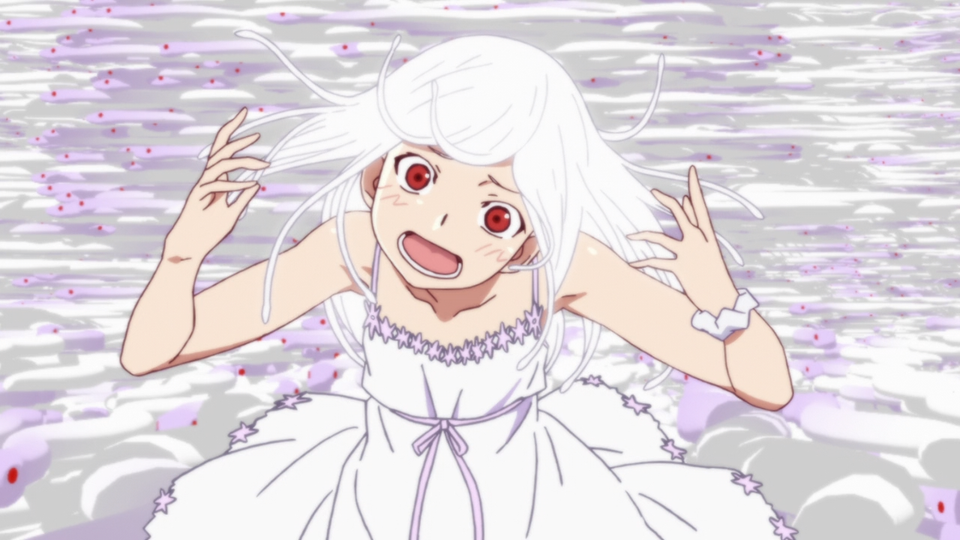
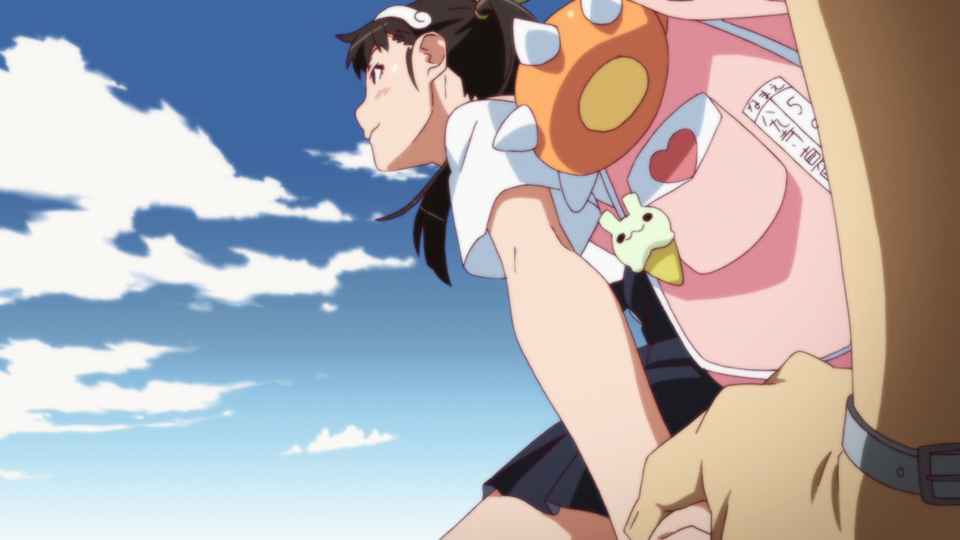
Araragi Koyomi is a third year high school student who is almost human again after having briefly become a vampire. One day, a classmate named Senjougahara Hitagi, who infamously never talks to anyone, falls down the stairs into Koyomi's arms. He discovers that Hitagi weighs next to nothing, in defiance of physics and common sense alike. Despite being threatened by her, Koyomi offers her help, and introduces her to Oshino Meme, a middle-aged homeless man who helped him stop being a vampire.

| Original Air Dates: | — ... |
|---|---|
| Country: | Japan |
| Genre: | Anime, Comedy, Supernatural |
| Network: | Tokyo MX |
| Watched by: | 9 587 1 008 335 |
| Total running time: | 2 days 55 minutes |
| Episode duration: | |
| Episodes: | 82 |
Found incorrect info?


Weakling.
I think someone noticed the word NisiOisin often flashing by. The fact is that the author of the original is Nishio Ishin, but the first and last names are written in a different romaji system and thus the phrase becomes a palindrome. And to emphasize this, the phrase is written as NisiOisin.
As for crabs:
おもし蟹 (Omoshi kani) - Crab of Memories
Omoishi kani – Heavy Crab
重石蟹 (Omoishi gani) – Heavy Stone Crab
Omoshi kami - The God of Memories
It is easy to see that they differ only slightly in Japanese pronunciation, so they are said to have descended from each other.
As for the second episode. Obviously, the author Nishio Ishin (NisiOisin) is very fond of wordplay.
So, when Araragi says "baka" (Fool), a picture appears with a horse, and then with a deer. That's because the Japanese word 馬鹿 (baka) consists of the kanji "horse" and "deer."
The story that happened to Senjougahara is based on the identical Japanese pronunciation of the words 重い(heavy) and 思い(thoughts).
And the words 重み(Omomi) and 重さ(Omosa) are also often used. Both words are nouns based on the kanji 重(heavy), but the endings ‐み and ‐さ differ. The ending -sa is more often used for real things, in our case — omosa (physical weight). The ending -mi is usually used for unreal things (a good example is 楽しし — Tanoshimi — happiness), so in this context it is more correct to say not just weight, but "inner" weight or just dignity.
As for the crab god (Omoshikami). As explained in this series, it was formed from (omoi – thoughts, memories) and (shigami – to cling, to hold on tightly) and it can be interpreted as 柵 (shigarami - bonds, connection).
Thus, this crab-god takes away difficult memories, including the bonds associated with them (in this case, with his mother).